“I can only work cash-in-hand [načerno] for the rest of my life,” Nina* told me as we were sitting in her kitchen drinking black coffee. She was rolling cigarettes from tobacco purchased in half kilogram packages after Ivan had left for his afternoon shift.
Nina was very helpful in advising me where to look for jobs, where to get the fit-for-work certificate and other required paperwork. She herself was unemployed. I sometimes tried to reciprocate by sharing with her some job openings I was aware of, until she matter-of-factly clarified one day that the size of her debts rendered any attempt of formal employment unfeasible. She would end up with less money than she had while being on benefits and occasionally taking cash-in-hand jobs without a contract. She estimated that her debt installments would come to at least half of her monthly wage.
Despite the stigma built around the trope of “excessive” spending by the Roma and their supposed lack of consideration for the future, the pathways to indebted lives that I observed had little to do with culture and a lot to do with the operation of capital. Most people would end up having debts because of various forms of non-payments: failures to pay transport fines; a failure to pay alimony after separation from a partner; non-payment for waste collection or utility bills; non-payment of compulsory health insurance during the times of unemployment.
Danek is a 28 year-old Roma man living in one of the hostels for low-income persons and families in “northern” Ostrava. During one of our conversations in late December 2016, he told me how he incurred significant debt for a failure to pay his health insurance when he was unemployed and the Labour Office removed him from the job-seekers’ register when he failed to show up for an appointment. He was not sure how much he owed.
When a family or an individual incurred unexpected expenses or simply did not get by one month, they had to turn to credit. A solution that was supposed to be temporary has turned permanent and the deceiving advertising of non-bank institutions was a significant factor.
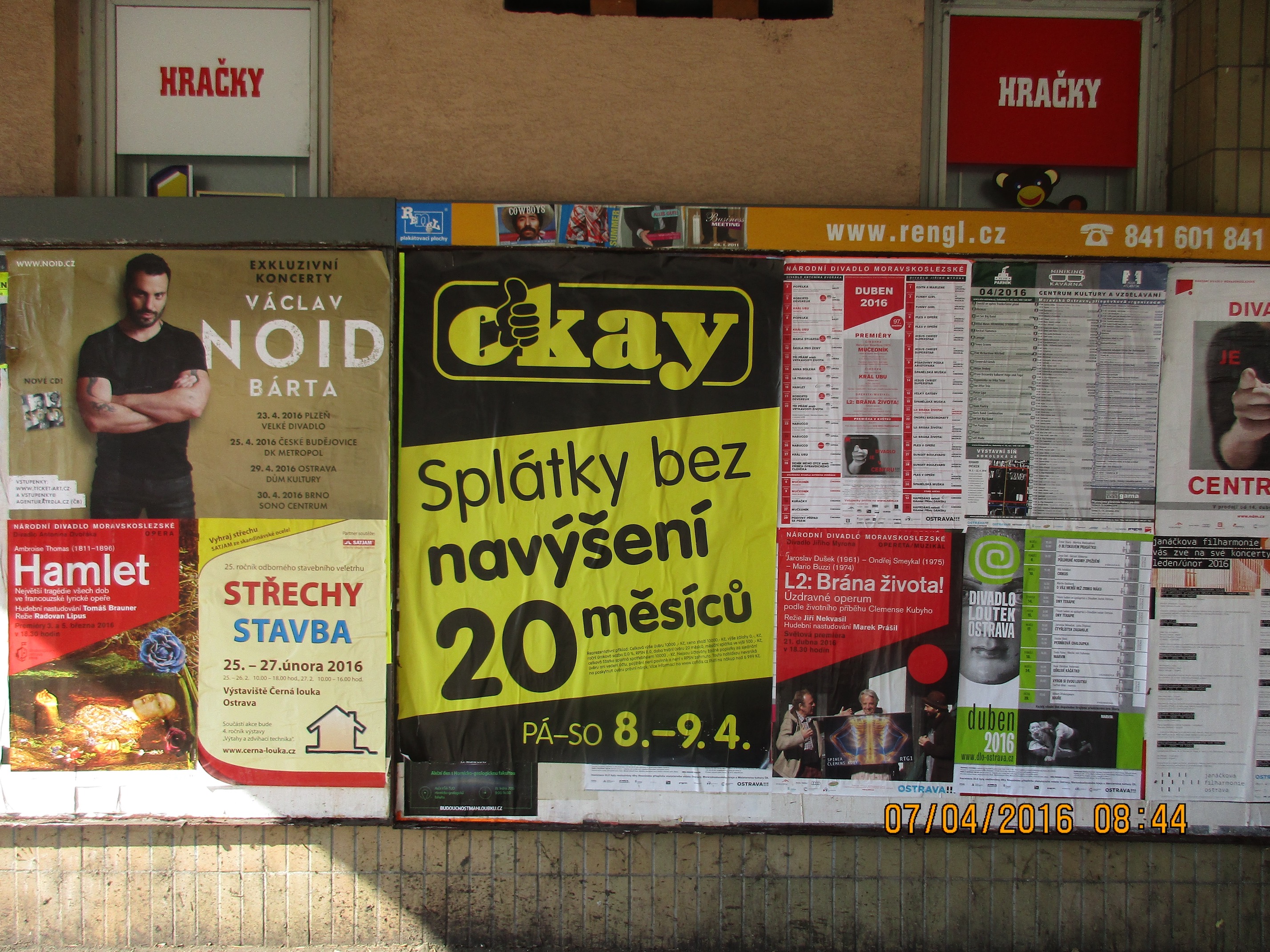
A poster about 1km away from Pěkná Street in an area with a supermarket, a hairdresser, a “Chinese” shop and a pub. The poster advertises consumer credit up to 10,000 CZK (316 GBP) and 0% interest during the first 20 months of repayments. What it fails to say is that annual percentage rate of charge is 24.7%, which means the consumer will pay these charges after the initial 20 months.
Formal debts were cited by a number of my informants as the main reason why it did not make sense for them to seek a job in one of Ostrava’s industrial zones. One day in August, I was chatting to Robert, responsible for a crew of street cleaners employed through the Labour Office. In his early 20s, Robert said that he used to work in a “Korean company” in the industrial zone some years ago. His gross monthly salary of 17,000 CZK (595 GBP) was cut every month by 5,000 to 6,000 CZK (175 to 210 GBP) due to debt claims. So he left the job and started working in street cleaning, being on close to a minimum wage, but incurring lower debt claim payments. [This was due to company’s policy of keeping the debt claims reasonable so that workers do not end up below subsistence level and eventually leave. This policy changed some months after I have left Ostrava].
An unsolicited advertisement received by my colleague at the street cleaning company. The advertisement says: “Are you experiencing unexpected expenses? Get a loan with a 50% discount.”
Hidden fees and rising interest equals excessive debts
Julek had a secondary education and worked for a moderate salary for over a decade. He grew up in an orphanage where he was exposed to the gajo [white] world, especially its cuisine. “I cook gajo food, so many Gypsies like to visit me and taste it.” Shortly after he left the orphanage in the 1990s, he became a victim of fraud. Somebody asked him to put his name under a fast loan application which he did upon an agreement that he will get part of the money. “I may have seen up to 30,000 CZK (1,050 GBP) out the total amount.” His debts have reached about 600,000 CZK (21,016 GBP) because he didn’t pay them back and the interest kept increasing the owed amount. His monthly wage gets cut every month due to repossession payments which render it fairly low. He lives in a dark dilapidated one-bedroom flat in a run-down neighbourhood.
Bible v Bailiffs
Bailiffs visited Nina quite frequently. I asked her how they behaved during those visits. Like “assholes” (hovada), she said curtly. “They shout and threaten us.” One of the first things she stated in this conversation was that the bailiffs are white [gádže]. “They find out the dates when we receive benefits and come.” At one occasion, she would not let them in. The violent behaviour of bailiffs was also mentioned also during my conversation with Julek. He once went with bailiffs to a family in the neighbourhood of …oz. We both knew the family in question – they were Born-again Christians belonging to a group colloquially called ‘Halleluyah’. During the visit of the bailiff accompanied by Julek, the family members presented a Bible and started preaching to them in defence (?). “Good that I went to that visit,” noted Julek, “he [the bailiff] would have been unnecessarily brutal”.
*All given names and names of locations are withdrawn to protect the privacy of people whom I met during my research.

 Ostravart