During my time in Ostrava, I was continuously taking notes of the narratives and imaginaries of the neighbourhood of Údol. They included stories of and about people who live there; but also stories of real estate agents whom I approached when looking for a flat; teachers in the local schools; employers or local activists.

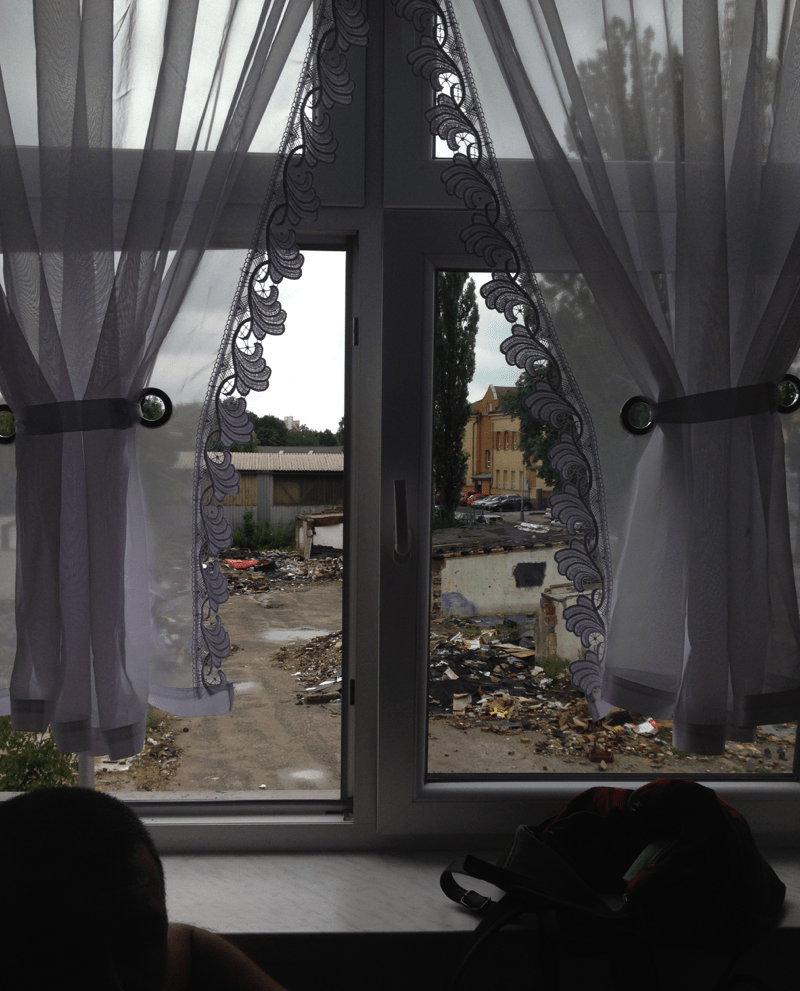
On the way to my morning meeting with a prospective employer, I have noticed that people cut their walk to Pěkná Street* through a shortcut between houses. Behind a warehouse-turned-into-a-gym was a big derelict space with old garages. A group of very young men were breaking or cutting pieces of the old walls using pickaxes. A man exiting a three-storey tenement overlooking the rubble whistled in my direction.
Later I became a frequent visitor to that house during my late morning chats over coffee and cigarettes with a Roma couple, Nina and Ivan, who rented a flat on the second floor. The “garage area” remained derelict until the end of 2016 when I left Ostrava.
I asked Nina if I could take picture of it one morning in the summer. “Yes, record it – show how they abandon it like this [for months] and then people say that the Gypsies destroyed it.”
Many residents attempted several times to move to a “better”, less segregated area. What ensued was a variation of the same scenario. The non-Roma residents would object, sometimes immediately during the visit, sometimes afterwards petitioning the council against renting a flat to Roma residents.
“We went to see a flat on Old Street. The moment we entered the hallway, the neighbours were outside. One of them told us that rents were high in the building… By the time we [finished the viewing and] got downstairs, they were all there. Mr …sky from the city council who went to the viewing with us, then returned to the house and discussed something with the residents for 10 minutes.”
Marta tells me about one her attempts to move from “Pěkná area”. She concluded that the best way to find a new place is to look for a location where “they have an experience with Roma. If there is none, it’s a dead end (je to zabitý)… you submit an application, they refuse it and refer you to Sandy Street [considered to be “a Roma area”]. It is better to say upfront during your first phone call that you are a Roma… In the past it [racism?] was rather covert; you were able to defend yourself during communism because there was legislation and there was work for everyone.”
Despite lack of any public leisure facilities, the neighbourhood was lively during the summer months – children playing on the side streets, women and men of various ages sitting on chairs in front of houses enjoying the sun. One of the irregular past-time activities was football tennis.
But these activities were slowly disappearing and the number of the residents was shrinking as the local authority was progressively selling the public housing . “I used to know almost everyone on Pěkná Street, it was very lively. I was leafleting in the area for six years.” We were sitting on the corner of their tenement with Sara and several relatives and neighbours. The children were running around, enjoying the last day before the school was about to start.
* All given names of people as well as names of specific streets are withheld to protect the anonymity of the people whom I met during my research.
 Ostravart